A Russian in Vietnam can still get dong from an ATM with a Visa or Mastercard issued outside Russia, or with a Mir card at VRB machines. Visa and Mastercard cards of Russian banks have not worked abroad since 5 March 2022, and a typical ATM charges a foreign card 50,000-165,000 ₫ or 2-5% per withdrawal.
Newcomers ask me about cash within the first week, usually after a card has already failed at the machine. The fees below come from official tariffs and 2026 ATM guides, and where sources disagree I give a range.
What does a Vietnamese ATM charge a foreign card?
A Vietnamese ATM charges a foreign card either a flat 50,000-165,000 ₫ per withdrawal or 2-5% of the amount with a 50,000-100,000 ₫ minimum, and some banks add 10% VAT on top. A 2026 fee index for travellers puts the national average at 2.85%, the third most expensive in Southeast Asia after Laos.
VietinBank publishes its tariff: since 16 November 2025 it takes 4% with an 80,000 ₫ minimum from cards of other banks, so a 3 million ₫ withdrawal costs 120,000 ₫, and the tariff is stated without VAT. Travellers report about 50,000 ₫ at Vietcombank and about 55,000 ₫ at Agribank and Sacombank. VPBank was reported in April 2026 to charge foreign cards nothing.
Your own bank adds a second fee for the cash advance and the currency conversion. The ATM screen may not show it, so the real price of a withdrawal appears only in your banking app after the money leaves the account.
Does a card from a Russian bank work in Vietnam in 2026?
A Visa or Mastercard issued by a Russian bank does not work in Vietnam, because both networks suspended their operations in Russia on 5 March 2022. UnionPay from Gazprombank stopped working abroad on 22 November 2024, and UnionPay from Rosselkhozbank and ATB works only sometimes.
Fintech cards are no way round it either. Media reports say that from late 2025 Wise blocked cards of Russians without residency in the EU, Switzerland or the EEA, and Revolut froze accounts of similar clients. That leaves a Visa or Mastercard from a bank in another country, which Vietnamese ATMs accept like any foreign card. Whether a Russian can open one depends on the bank, so check its site first.
Without a working card the trouble is not limited to the ATM. The e‑visa form on the government portal is public, but the portal rejects many foreign bank cards, so the fee cannot always be paid. BestBus Vietnam covers that gap: I pay the fee with my own card, choose the right entry point and refile for free with a refund if the visa is refused, as described on the 90-day e‑visa page. Send me the dates you need the visa for and I will pay the fee and file the form.
Which limit applies to one withdrawal?
Most Vietnamese ATMs cap one withdrawal at 2-10 million ₫, and the figure depends on the bank. VPBank allows up to 10 million ₫ per operation according to an April 2026 guide, Vietcombank 2-5 million ₫, and ACB 3 million ₫. The ATM shows its own cap before you confirm. Machines run around the clock and take Visa, Mastercard, UnionPay and JCB, so the network printed on your card matters less than the rules of the bank that issued it.
Vietnamese banks do not publish a daily number of withdrawals for foreign cards. The daily ceiling comes from the bank that issued your card, and the notes left in the machine set the practical limit. Where the bank charges a flat fee per withdrawal, one large withdrawal costs less than three small ones.
Should you decline the currency conversion at the ATM?
Yes, always decline it. Many machines offer to bill you in your own currency, called dynamic currency conversion, and then the Vietnamese bank sets the rate and the markup. Press “Decline conversion”, “Without conversion” or “Charge in VND” and the withdrawal is booked in dong, with your own bank doing the conversion afterwards.
Visa’s DCC page says the rate and the markup must be shown before you choose and advises declining when they are unclear. Refusing does not stop the machine from paying out. The screen usually offers the choice right after you enter the amount, so read it before pressing the confirm button, because the first option shown is not always the cheaper one for you.
Is the Mir card worth carrying?
Carry Mir only as a backup, because it pays out cash at one bank: VRB, a Russian-Vietnamese joint venture. VRB announced the link to the Russian NSPK and Vietnam’s NAPAS networks on 29 October 2019 and describes it on its website.
A 2026 guide counts 21 VRB machines, listed on the bank’s ATM page: five in Vung Tau, four each in Nha Trang and Da Nang, three each in Hanoi and Ho Chi Minh City, two in Hai Phong. Reviews put the cap at 2-5 million ₫ per withdrawal, and the total loss to ATM fee, conversion and the Russian bank’s commission at 3-11% depending on the issuer.
Should you carry dollars as a backup?
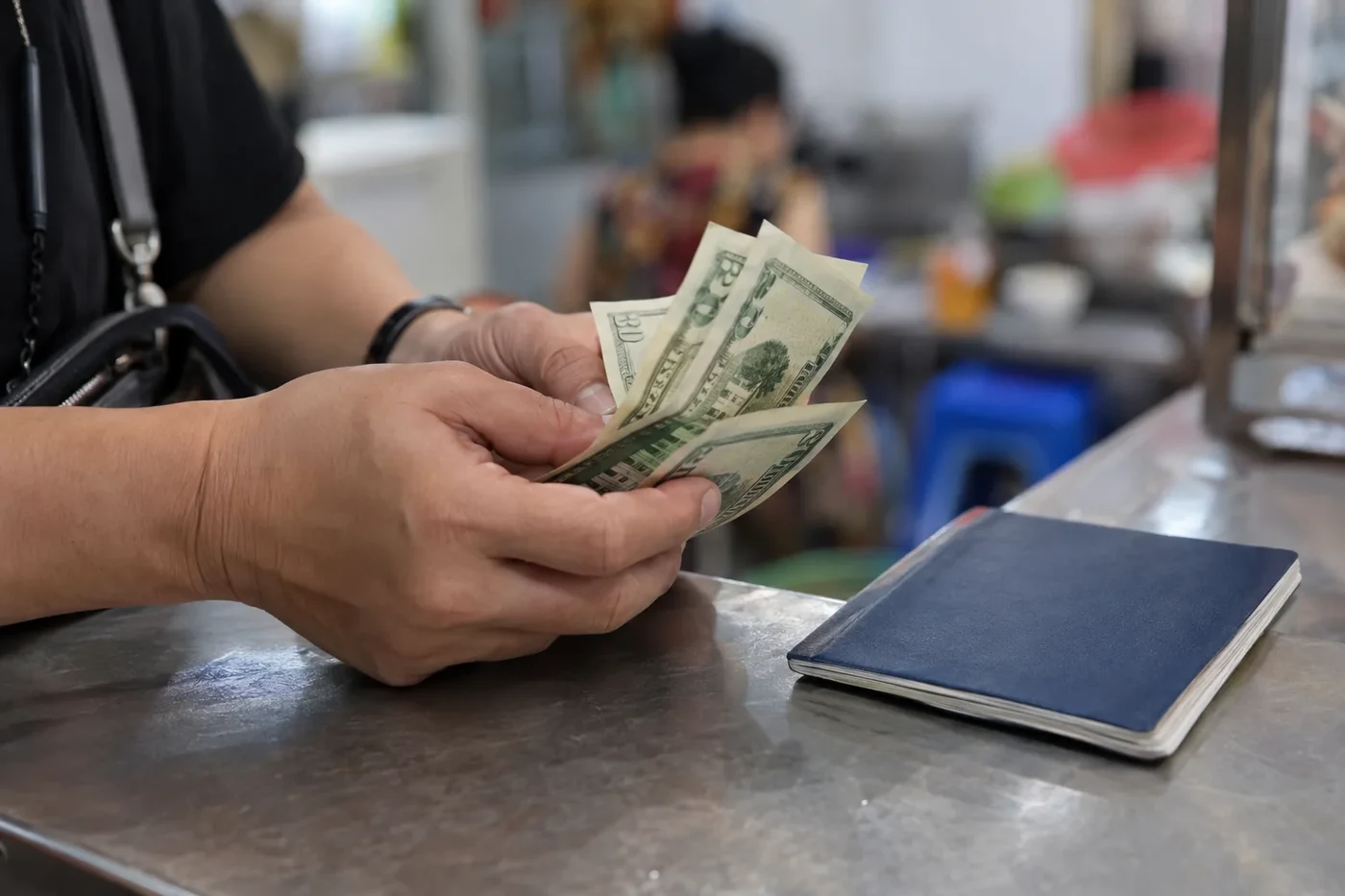
Yes, a small reserve of US dollars is the fallback when no card goes through. Guides estimate the loss at 0.5-1.5% in a bank or licensed exchange office, and at the airport the rate runs 5-10% worse. Avoid exchanging with private individuals or in Telegram chats: Decree 340/2025/ND-CP, in force since 9 February 2026, fines currency exchange outside authorised places.
For the other ways to pay see my guide to cards versus cash in Vietnam, and for exchange counters see the article on exchanging money in Vietnam.
Which option fits which situation?
Pair a Visa or Mastercard from a non-Russian bank with a zero-fee machine such as VPBank, keep Mir for VRB machines as the backup, and hold a reserve of dollars for the day nothing works. Withdraw close to the machine’s cap, decline the conversion, and check the final cost in your own banking app.
| Bank or method | Fee for a foreign card | Cap per withdrawal | Source of the figure |
|---|---|---|---|
| VPBank | 0 ₫ | up to 10 million ₫ | guide, April 2026 |
| Vietcombank | about 50,000 ₫ | 2-5 million ₫ | 2026 guides |
| VietinBank | about 120,000 ₫ on 3 million ₫ | not stated | official tariff from 16 Nov 2025 |
| Agribank, Sacombank | about 55,000 ₫ | not stated | traveller reports |
| ACB | amount unconfirmed | 3 million ₫ | guide, April 2026 |
| VRB, Mir card | VRB tariff plus your bank’s fee | 2-5 million ₫ | 2026 reviews |
With the cash question settled, the next thing that usually bites is the visa deadline. Filling in the e‑visa form takes an evening on the portal, but a rejected payment a week before the stamp expires is where days get lost. Message me on WhatsApp with the date your visa ends and I will check the timing with you.
Methodology: where these numbers come from
Official sources: the VietinBank tariff in force since 16 November 2025, the Visa and Mastercard statements of 5 March 2022, VRB’s announcement of the Mir connection dated 29 October 2019, and Visa’s page on dynamic currency conversion. Limits and fees for the other banks come from independent ATM guides for Vietnam published in 2026 and from traveller reports, and the figures were checked on 17 October 2026.
Vietnamese banks change tariffs without a separate announcement, so read the final fee on the ATM screen before you confirm. Amounts are shown in dong, as the banks show them.
Frequently asked questions
Is a four-digit PIN enough?
Usually yes, Vietnamese ATMs mostly take four digits. Ask your bank before the trip whether your PIN format works abroad.
Can I take cash from a credit card?
You can, but it counts as a cash advance: interest starts on the day of the withdrawal and the bank adds a fee. A debit card is normally cheaper, so read your bank’s tariff first.
Does the Mir card pay in Vietnamese shops?
Hardly ever. The BIDV and VRB terminals for Mir are not set up and the staff do not know the card, so travellers use Mir in Vietnam for cash only.
Will the ATM give me dollars or rubles?
No, Vietnamese ATMs pay out dong only. Dollars are available at a bank or a licensed exchange office.