Russia’s 45-day visa-free access to Vietnam applies to air arrivals — and so does Vietnam’s new Pre-Arrival Information declaration. Since June 22, 2026, every foreigner arriving by air at a Vietnamese airport must complete the pre-arrival declaration before check-in, including travelers who don’t hold a visa. No pre-arrival QR code, no boarding pass. It’s free, takes under 10 minutes, and the question most Russians get wrong is what to select in the visa type field when they have no e-visa at all. If you’re still deciding between routes in the first place, I compared the e-visa, visa on arrival and a visa run side by side.
I work with Russia-to-Vietnam travel every week. This guide covers exactly what visa-free Russians need to know: what to fill out, what to skip, and when the pre-arrival declaration doesn’t apply at all.
Do Visa-Free Russians Need to Fill Out Vietnam’s Pre-Arrival Information Declaration?
Yes — visa-free status does not exempt you from the Pre-Arrival Information requirement. Since June 22, 2026, the Pre-Arrival Information declaration is mandatory for all foreign nationals arriving in Vietnam by air, regardless of whether they hold a visa, an e-visa, or are entering on visa exemption. Russia’s 45-day visa-free access to Vietnam (valid through March 14, 2028) changes nothing about the pre-arrival obligation. For the wider picture of how Russians enter Vietnam — the 45 free days, the e-visa, and what comes next — see the full Vietnam visa guide for Russian citizens.
The Pre-Arrival Information declaration replaced Vietnam’s old paper arrival card. Every air passenger arriving internationally — on a tourist stay, long-term expat return, or visa-exempt entry — must complete the digital form at evisa.xuatnhapcanh.gov.vn and show the resulting QR code at check-in and immigration.
Early publications from April 2026 called it “optional” — that was during the gradual rollout phase. By June 22, 2026, the system became mandatory across all five Vietnamese international airports.
Who is exempt: Transit passengers who stay in the international zone without clearing Vietnamese immigration. Diplomats and official delegations. All other foreign nationals arriving by air must complete the Pre-Arrival Information declaration.
What to Select in the Pre-Arrival Information Form When Entering Without a Visa
This is where most visa-free Russians make mistakes. In the Pre-Arrival Information form’s visa type or entry basis field, select “Visa Exemption” (or “Unilateral exemption” — labeling varies slightly by form version). Do not choose “e-visa” if you don’t hold one; the form will then ask for an e-visa reference number that you don’t have.
| Entry Type | When to Select It |
|---|---|
| Visa Exemption | Entering on Vietnam’s bilateral or unilateral visa-free agreement — no visa document required. Correct for Russians. |
| E-visa | You hold an approved Vietnam e-visa from evisa.gov.vn and have the reference number. |
| Sticker visa / Visa on arrival | Embassy visa sticker or prior visa on arrival approval. |
| Diplomatic / Official passport | Government travel documents only. |
After selecting “Visa Exemption,” the e-visa reference number field disappears — it’s not needed for your entry type.

Step-by-Step: How to Complete Vietnam’s Pre-Arrival Information Declaration as a Visa-Free Russian
The Pre-Arrival Information form is available at evisa.xuatnhapcanh.gov.vn. You can submit it starting 72 hours before your scheduled arrival — not earlier.
- Open the portal — navigate to the Pre-Arrival Information section. The interface supports English.
- Enter your passport details — full name in Latin characters exactly as printed on your passport, document number, nationality (Russian Federation), date of birth, passport expiry date, gender.
- Select your entry basis — choose “Visa Exemption.” The e-visa reference field is not required.
- Enter your flight details — airline name, flight number, scheduled arrival date and time, destination airport code: SGN (Ho Chi Minh City), HAN (Hanoi), DAD (Da Nang), PQC (Phu Quoc), CXR (Nha Trang/Cam Ranh).
- Add accommodation address — name and address of your first night’s hotel in Vietnam, in Latin characters.
- Submit and save the QR code — the portal generates a QR code immediately. Screenshot it or download the PDF. You present this at airline check-in (as your pre-arrival proof) and again at Vietnam immigration control.
Total time: 5–10 minutes. A valid QR code is entry-specific — if you change your flight, fill out a new form with updated flight details.
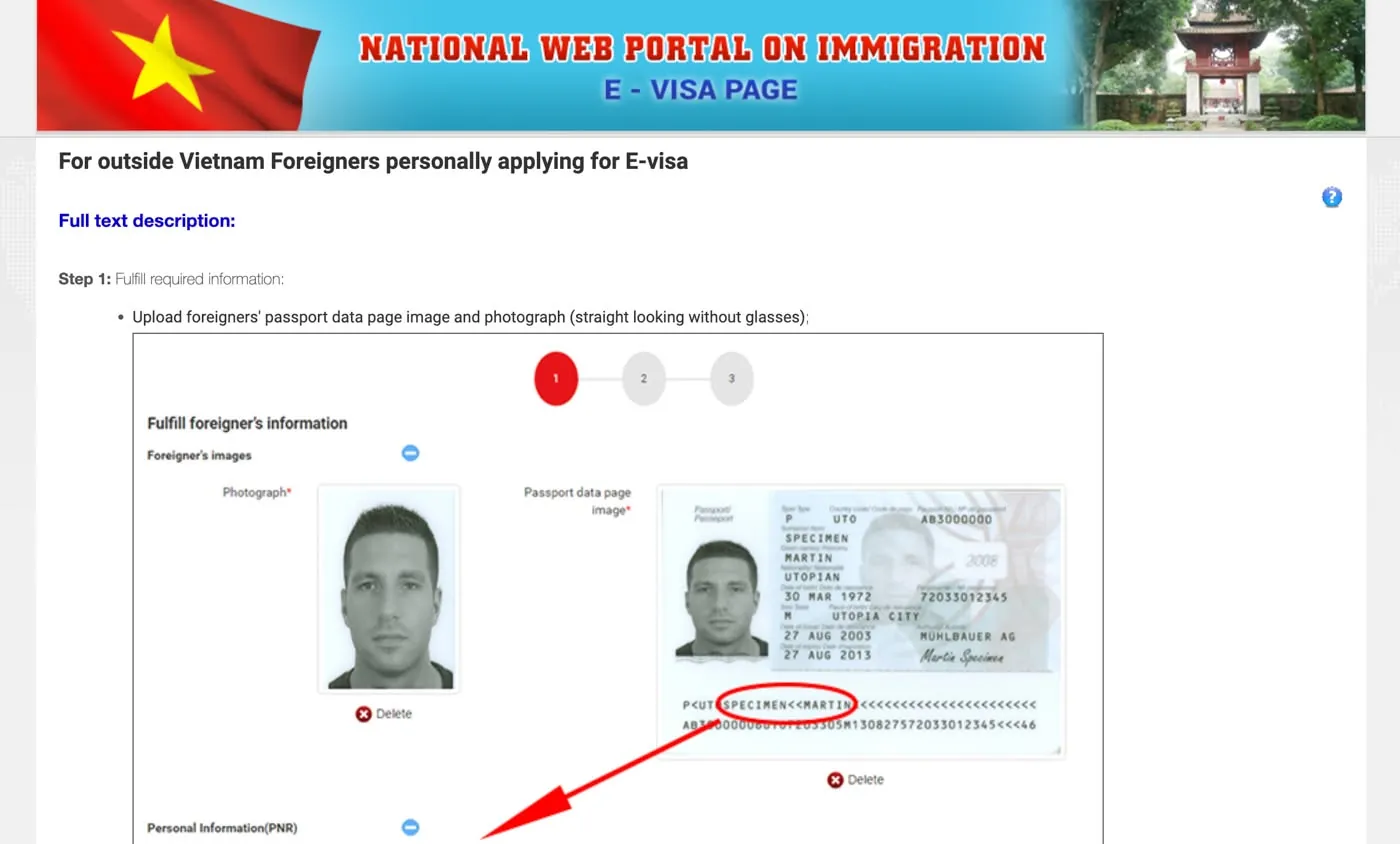
If you’re pairing this trip with an e-visa rather than the visa-free entry, that’s where the portal usually trips people up — foreign cards get rejected right at the payment step. I fill the form, pay the $25 fee with a card that clears, and walk you through the pre-arrival declaration on top of it — message me on Telegram with your dates and I’ll sort both before you fly.
Pre-Arrival Information and Visa Runs: Lao Bao, Moc Bai, and Airport Re-entry
Overland visa runs do not require a Pre-Arrival Information declaration. The system is air-only. If you’re resetting your 45-day stay at a land border crossing — Lao Bao, Moc Bai, Ha Tien, Prek Chak — you cross out and back in without any digital pre-arrival registration.
For air-based re-entry or trips that combine an overland visa run with a flight back into Vietnam, a new pre-arrival form is required for each air arrival. The form is entry-specific — it captures your particular flight number and arrival date — so it cannot be reused across different trips.
| Situation | Pre-Arrival Information Required? |
|---|---|
| Flying into Vietnam for the first time | Yes |
| Re-entering by air after any trip abroad | Yes (new form per flight) |
| Re-entering overland after a visa run (Lao Bao, Moc Bai) | No |
| Transit through Vietnamese airport without clearing immigration | No |
| Returning expat arriving by air on a residence card | Yes |
Most Russians doing regular visa runs from Da Nang take the bus to Lao Bao. For that route, no Pre-Arrival Information declaration is needed for re-entry. If you fly in or out of Vietnam for any leg of your stay reset, the pre-arrival declaration applies to that air arrival. If you’d rather not track the bus timetable yourself, our Lao Bao visa-run service from Da Nang handles that crossing door to door.
What Happens If You Skip the Pre-Arrival Information Declaration or Enter Wrong Details
Missing the Pre-Arrival Information declaration does not result in a fine under current Vietnamese regulations (as of June 2026). In practice, two scenarios:
At check-in with time to spare: the airline may ask for your Pre-Arrival Information QR code. You fill out the form on airport Wi-Fi and return to the counter. This works if you have 20–30 minutes before check-in closes.
At check-in last minute: you miss your window. The form takes 5–10 minutes, but airport connectivity under load is not guaranteed.
At immigration without a Pre-Arrival Information declaration, your data is entered manually at the border control desk — typically adding 40–60 minutes to processing during peak season.
Wrong details (mismatched passport number, incorrect flight number) mean the QR code won’t scan correctly and you’ll need to fill out a new form. Always verify your passport number digit by digit — it’s the most common error.

Russia’s 45-Day Visa-Free Access and Pre-Arrival Information: Key Facts for 2026
Russia’s visa-free agreement with Vietnam runs through March 14, 2028 (a three-year extension signed in March 2025). The allowance is 45 days per entry, with no restriction on the number of entries per year.
How the 45-day visa-free period and the Pre-Arrival Information declaration interact:
- The Pre-Arrival Information declaration is a pre-registration formality, not a visa. It doesn’t start or extend your stay.
- The 45-day clock begins from the actual entry stamp at immigration — not from when you submit the pre-arrival declaration.
- A land border visa run resets your 45-day counter without requiring a Pre-Arrival Information declaration.
- Each air arrival resets the counter but also requires a new pre-arrival form.
Frequently Asked Questions
Do visa-free Russians need to complete Vietnam’s Pre-Arrival Information declaration in 2026? Yes. The Pre-Arrival Information declaration is required for all foreign nationals arriving by air in Vietnam since June 22, 2026, including those entering on visa exemption. Visa-free status does not exempt you from pre-arrival registration.
What do I select in the Pre-Arrival Information form if I have no visa? Select “Visa Exemption” in the entry type or visa type field. For Russians entering under the bilateral visa-free agreement, “Visa Exemption” is the correct selection — do not choose “e-visa.”
Is the Pre-Arrival Information declaration required for overland visa runs through Lao Bao or Moc Bai? No. The pre-arrival declaration applies only to air arrivals. Overland border crossings — Lao Bao, Moc Bai, Ha Tien, Prek Chak — are currently not included in the system. No pre-arrival registration is needed for land entry or re-entry.
How long is Russia’s visa-free period in Vietnam? 45 days per entry, valid through March 14, 2028 under the three-year extension signed in March 2025.
What happens if I fill out the Pre-Arrival Information declaration but then change my flight? The pre-arrival QR code is linked to specific flight details. If you rebook, submit a new pre-arrival form with the updated flight information within 72 hours of the new arrival.
Where do I fill out the Vietnam Pre-Arrival Information declaration? The official portal is evisa.xuatnhapcanh.gov.vn — navigate to the Pre-Arrival Information section. There is no official mobile app for it as of 2026.
- Best Bus Vietnam — danangvisarun.com — e-visa applications, visa runs, and transfers from Da Nang
- Telegram @learnx1000 — message me for visa and Pre-Arrival Information questions