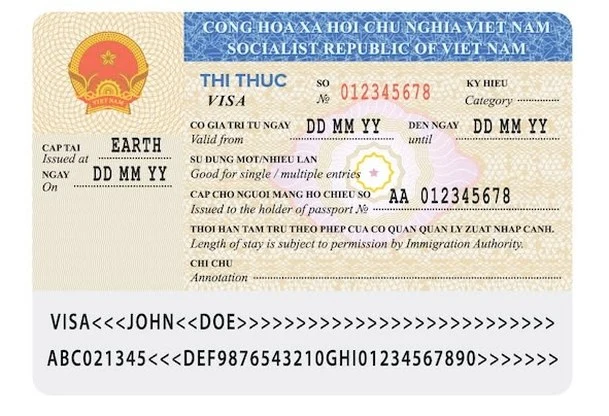
If your 90-day Vietnam e‑visa is running out and you’re planning to stay another few months, you have two ways to pay for it. One is the panic-mode border run everyone books at the last minute. The other is a paired filing that costs $62 less and needs a bit of planning ahead. Here’s the actual math, from someone who runs this route for clients.
The two prices side by side
Rush route (border transport plus a visa turned around in hours): about $150 - on top of the $55 you already paid for the standard e-visa that got you into the country. That’s $205 for the same six months. This is what most travelers end up paying when they realize their visa is about to expire and they haven’t filed anything yet.

Planned pair: both e-visas filed together with overlapping dates at the standard rate - $55 + $55 = $110, government fees included - plus one border crossing transfer at roughly 850,000 VND ($33). Total: $143 for 180 days of legal stay.
The two routes split at the moment you decide, not at the second visa. Commit to six months up front and both visas go at the standard rate - $55 + $55 = $110 - and $143 covers the whole half-year including the transfer. Put the decision off and you’ve already bought a single standard e-visa for $55, which leaves only the $150 rush route when it expires - $205 in total, $62 more for the same 180 days.
Note what the argument no longer rests on. At $55 the e-visa isn’t pocket change, and “just buy two, they’re cheap” stopped being the reason a while ago. What still holds is the shape of the spend: there’s no package discount, but two visas plus a planned transfer still cost less than one visa plus a purchase made under time pressure at the border.
Why the timing has to be planned, not improvised
The e‑visa is valid for 90 days and cannot be extended from inside the country. The clock starts on the entry date you listed on your application - not the date you actually crossed the border. And the portal’s official “3 working days” processing time usually plays out as 5-7 calendar days in practice, so filing the second visa the week your first one expires is cutting it close. This part can be handed over end to end: we run the standard tariff on an up to 5 business days turnaround, which is exactly why the pair has to be started early rather than mid-panic - what that covers is on our Vietnam e-visa 90 days page.
The way we run this for clients: the second e‑visa gets an entry date that overlaps the tail end of the first one by 2-3 days. We’ve submitted this on the portal for real clients, repeatedly, and it’s been accepted every time. To be precise about what we know and don’t: there’s no written rule from the portal permitting two active e-visas at once, but there’s also no rule banning it - this is a gray zone where we’re going on our own track record, not on a guess.
Some commercial visa agencies warn travelers off this with the term “ghost entry,” implying two overlapping e-visas will somehow cancel each other out. In our experience that hasn’t happened once - the two entries are processed as independent permissions, not mutually exclusive statuses.
A concrete example on a calendar
Here’s how this plays out with actual dates (the schedule is real, the exact dates are a stand-in). Entry on January 1, first e-visa valid through March 31. We don’t wait until March 28-29 to file the second one - we file it in the first half of March, leaving room for the real 5-7 calendar days of processing instead of the official “3 working days.” The second e-visa’s entry date gets set to March 28-29, two to three days before the first one runs out. From April 1 onward the traveler is on the second visa, valid through the end of June. Net result: six months in the country from one planning pass, not two separate scrambles with two document sets and two border transfers.
If that same traveler waited until the last week of March to even think about it, the rush route is the only option left, because there’s no longer enough runway for normal processing.
Is the $62 worth planning for
In absolute terms, $143 versus $205 is a real gap - $62 on a six-month stay. That’s not a rounding error, but it’s also not the whole argument any more: the price of waiting is mostly the final week before a visa expires, when the cheap options have already expired with it and a rushed application still has to clear in time. The overlap schedule buys the same 180 days at the lower number without racing the portal.
A side benefit most people don’t think about
If you hold a Vietnamese bank card (MasterCard), renewing it requires an active visa - a visa-exempt entry stamp won’t work for that. Running two e-visas back to back solves that in passing. It also means one border run every 90 days instead of every 45 - half the trips to the checkpoint.

The one number that hasn’t moved
The government fee itself hasn’t changed: $25 for single-entry, $50 for multiple-entry - that part of the math is fixed regardless of which route you pick. What changes is only the service side: how much you pay someone to file it, how far ahead you file, and how many border transfers you end up buying. That’s the whole lever behind the $143-vs-$205 gap above.

Bottom line
The math only works if you’re planning six months out, not scrambling in the final week. A paired filing of two e-visas plus one border transfer - $143 - beats the $205 rush route on price and on stress, and it solves the MasterCard renewal question along the way. If there’s no six-month plan and the visa runs out next week, the rush route is the right call - no argument there.
We’ve already covered the timing question - how many days before expiry to file the next e‑visa in detail - this piece is about the money side of the same decision.
If you want us to map this out against your actual dates, message me on Telegram and I’ll walk you through the filing schedule and the real cost for your case.